
Every cash-on-delivery store has two filters between an order and its money. The first is the confirmation step, where you try to reach the buyer. The second is the door, where they accept or refuse.
Most merchants spend their attention on the second one. The first is cheaper to fix, happens earlier, and decides how many parcels ever reach a door at all.
What confirmation rate is, and what it is not
Confirmation rate is the share of placed orders that someone successfully confirms before dispatch. Not the share that get delivered — that is the delivery rate, and it is measured later and separately.
Published guidance puts a well-run operation at 60–80%, with the best operators confirming 85–95% and doing it fast. Below 50% is usually a signal that something is structurally wrong rather than that your customers are unusual.
The two rates multiply. 70% confirmed and 80% delivered means 56 of every 100 orders ever get paid for. Improving either one moves the same final number, and confirmation is normally the cheaper of the two to move.
An unconfirmed order is not a free order
It is easy to treat the orders you never reached as harmless — nothing shipped, nothing lost. That is wrong in one important way: you already paid for them.
Every unconfirmed order consumed its full share of advertising. If a quarter of your orders never get confirmed, a quarter of your ad budget bought nothing at all. That cost is invisible because it never appears as a return or a refund; it just quietly lowers the profit on the orders that did work.
Which is why confirmation rate deserves a line in your reporting rather than being a thing the call centre worries about.
Why you cannot reach people
In rough order of how often it is the real cause:
| Reason | What it actually means |
|---|---|
| You called when they could not answer | The single biggest cause, and the one nobody measures |
| You called too late | Enthusiasm decays within hours, not days |
| The number has a typo | One digit, and the order is unreachable from the start |
| They did not recognise the number | An unknown mobile calling twice reads as a scam |
| They changed their mind | A real answer, and the only one on this list that is not fixable |
Note that four of the five are about the mechanics of the call, not about the customer’s intent. That is the good news.
What moves the number
Ask the buyer when to call
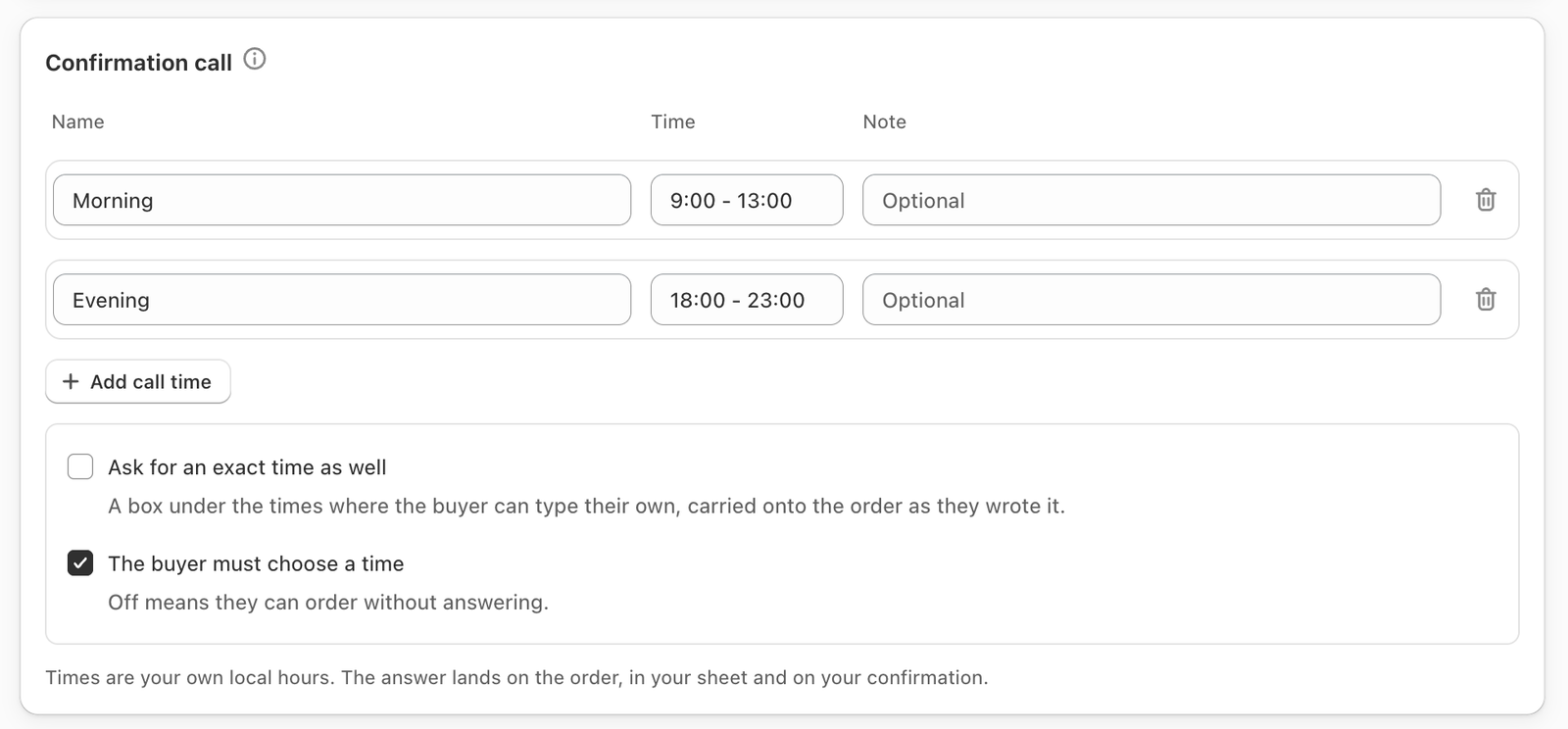
This is the highest-return change available and almost nobody does it. A question on the order form — morning, afternoon, evening — costs one line and turns a cold call into an appointment.
It works for a reason beyond scheduling. A buyer who picked a window has made a second small commitment to the order, and people answer calls they have agreed to.
Call fast
The gap between the order and the first attempt matters more than the number of attempts. Within the hour is a different conversation from the next afternoon, because the buyer still remembers the ad, the product and the decision.
If you can only improve one operational thing, improve the delay, not the script.
Validate the number while they are typing
A phone field that checks the shape of the number against the country before the order is placed removes an entire category of unreachable orders at zero ongoing cost. You cannot catch a deliberately wrong number, but you catch every typo.
Try a different hour, not the same hour again
Three attempts at 11am on three consecutive days is one attempt repeated. If someone works mornings, you have learned nothing new each time. Vary the window before you vary the number of calls.
Know when to stop
Every attempt costs money and the hit rate falls steeply. Two or three well-spaced attempts captures nearly everyone who was ever going to answer; the fourth and fifth mostly burn call-centre minutes on orders that were never real.
What does not move it
- A longer script. The call either connects or it does not; what you say matters far less than whether anyone picks up.
- More attempts. Past three, you are paying to confirm something you already know.
- Calling from a different number each time. It looks like a scam and reduces pickup.
- Email follow-ups. In most COD markets the email address is half-invented and never read.
The number nobody computes: cost per confirmed order
Take your monthly call cost — agent time or outsourced fee — and divide it by confirmed orders, not by attempts.
That single figure tells you whether a fourth attempt is worth making, whether an extra agent pays for themselves, and whether an outsourced call centre is cheaper than it looks. Most stores have never calculated it, and most are surprised by the answer.
It also slots directly into the profit model in what a cash-on-delivery order really earns you, where confirmation cost is one of the six costs every COD order carries.
Tracking it
Shopify records an order as created and never hears another thing about it, so confirmation rate has to come from your own workflow. The minimum viable version is a column in a spreadsheet: ordered, attempted, confirmed, dispatched.
CODPrem builds the question into the form — the buyer picks the window when they can answer — and records whether an order was confirmed, so the rate appears on the dashboard next to the delivery rate rather than in a separate file. Orders can be marked confirmed by hand or in bulk once the calls are done.

Common questions
What is a good confirmation rate?
60–80% is a normally functioning operation, 85%+ is strong, under 50% means something is broken rather than unlucky. But judge yourself against last month rather than against a benchmark — your product and price point move this number more than your process does.
How many times should I call?
Two or three, spread across different times of day. Past that the hit rate rarely justifies the cost. Measure your own: record which attempt number produced each confirmation, and the right cutoff becomes obvious within a month.
Should I confirm every order, even small ones?
Compare the cost of the call with the cost of a return on that order. For low-value items the return can cost less than confirming, in which case ship without calling and accept the refusals. That calculation is specific to your prices.
Does confirming orders hurt conversion?
No, because it happens after the order is placed. Asking when to call does add one question to the form, which is the only conversion cost involved — and it is a choice between three buttons, not typing.
Where to start
Add the “when should we call you” question to your form, and start recording which attempt number produced each confirmation. The first change raises the rate; the second tells you what your calls actually cost. Together they take an afternoon.