
Shopify’s checkout is one of the most tested purchase flows on the internet. It is also built for card payments, and it shows the moment the payment method is cash handed to a driver.
The question is not which is better in general. It is which loses fewer cash on delivery buyers between the product page and a confirmed order. This article sets out what each one does, where the difference comes from, and when the standard checkout is still the right answer.
What the standard checkout asks a COD buyer to do
A buyer who wants to pay cash goes through the same sequence as a buyer paying by card:
- Add to cart.
- Open the cart.
- Press checkout.
- Fill contact details on one screen.
- Fill the shipping address on the same or next screen.
- Choose a shipping method.
- Reach the payment screen and find the cash on delivery option among the card fields.
- Press complete order.
Three of those steps exist because of card payment. The cart page exists so a buyer can review before paying. The payment screen exists so a card can be entered. The separation of contact and address exists so a card can be verified against a billing address. A buyer paying cash on the doorstep needs none of this, and each screen is a chance to leave.
What a one-page form does instead
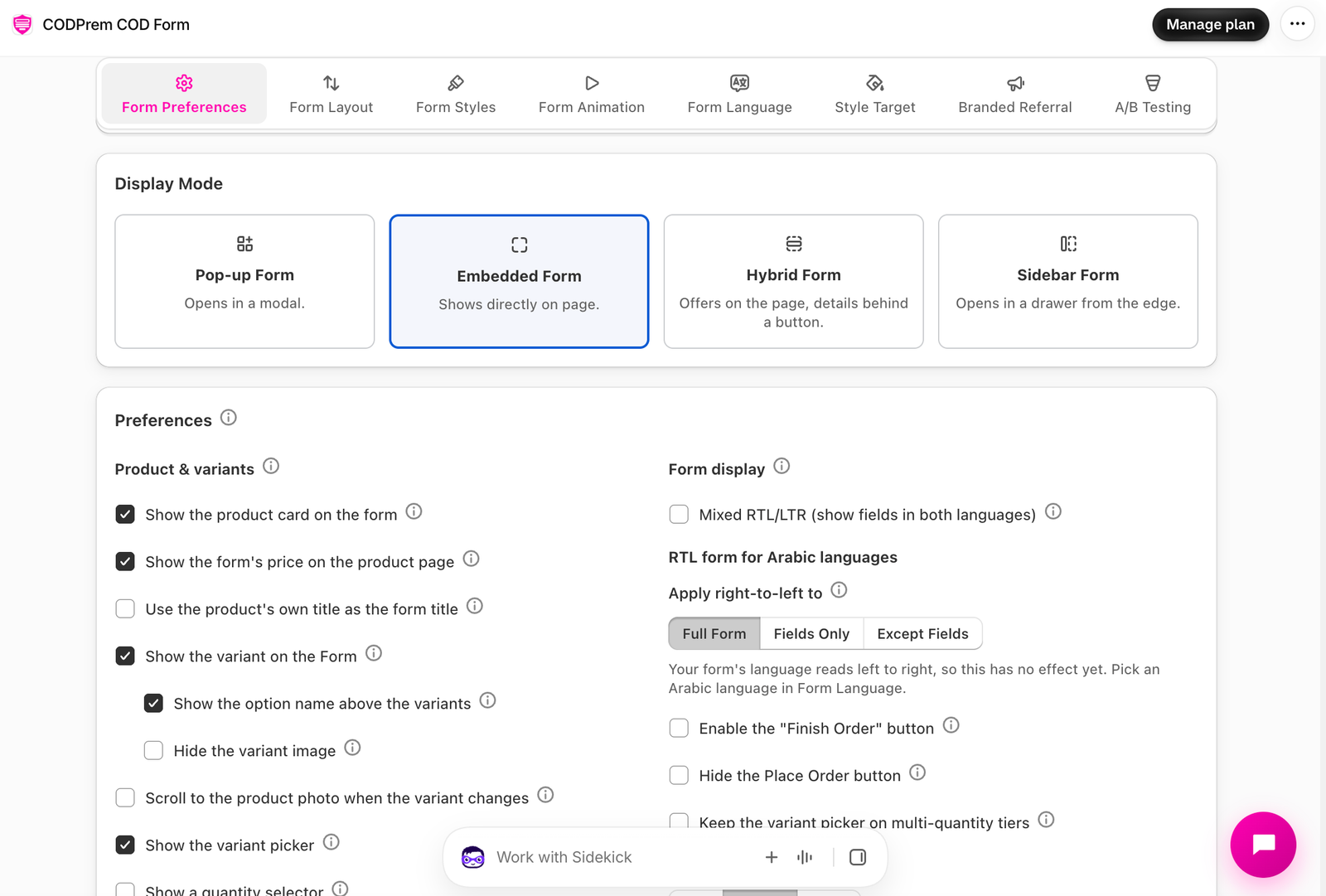
The form replaces the buy button on the product page itself. The buyer is already looking at the product, so there is no cart, no navigation, and no payment screen. They give a name, a phone number and an address, choose a shipping method if you offer several, and press order.
Nothing about that is a trick. It removes steps that were only ever there to collect card details.
Where the numbers come from
Take 10,000 product-page visitors. Two things move: how many reach a point where they are entering details, and how many finish once they start.
| Shopify checkout | One-page form | |
|---|---|---|
| Product page visitors | 10,000 | 10,000 |
| Reach the details stage | 620 | 940 |
| Complete | 41% | 63% |
| Orders | 254 | 592 |
| Revenue at 45 | 11,430 | 26,640 |
The figures above are illustrative, not a promise. Use them as a shape rather than a forecast: the first row moves because fewer screens sit between the product and the form, and the second moves because the buyer is asked for less. Your own split will be different, and the only way to know it is to measure both on your own traffic.
What is not illustrative is the direction. Every step removed from a purchase path removes a place to abandon, and this is true whatever the market.
The four things the standard checkout cannot do for COD
It cannot confirm the phone number is real
A card payment authenticates itself. Cash on delivery authenticates nothing until the driver knocks. The checkout collects a phone number as a contact field, with no validation beyond a format check, and a wrong number is a parcel nobody can call about.
It cannot apply a discount for paying now
Offering a few percent to a buyer who pays by card at the moment of ordering is one of the most reliable ways to improve cash on delivery economics. The standard checkout treats both payment methods identically, so the incentive has nowhere to live.
It cannot make the order bigger at the right moment
The moment a cash buyer is most willing to add something is while they are deciding, not after. Quantity offers, bundles and a matched second product belong on the screen where the order is being placed, which in the standard flow is a screen you do not control.
It cannot block an address that already cost you
A phone number that refused three parcels will place a fourth order through the standard checkout without anything stopping it. Rules of that kind have to live where the order is created.
When the standard checkout is still right
There are real cases where it is, and sellers lose money by switching without reading them:
| Situation | Why the standard checkout wins |
|---|---|
| Most of your orders are prepaid by card | You would be rebuilding a flow that already converts, to serve a minority |
| You sell subscriptions or digital goods | Nothing is handed to anybody at a door; the whole premise is absent |
| Your market has very high card use and low refusal | The cash on delivery problems this solves are not your problems |
| You depend on a checkout extension you cannot replace | A tax, fraud or finance app that only runs in checkout is a hard dependency |
The honest position is that these are alternatives for the same order, not a replacement for your store. A form that takes cash orders and a checkout that takes card orders can run side by side, which is what most cash on delivery sellers end up with.
What a one-page form has to get right to be worth it
A shorter form is only an improvement if it still produces a correct, deliverable order. Four things decide that:
- The address has to be usable. Fewer fields must not mean a vaguer address. Address autocomplete, and a country and region that come from a real list rather than free text, do more for delivery rate than any wording change.
- The phone number has to be checked. Not just present, but a real number for the country you deliver to.
- The price shown must be the price charged. Any offer applied on the form has to be priced by the server from the real product data, or you will ship orders at figures you did not agree to.
- It has to work on a slow phone. Most cash on delivery traffic is mobile, often on a mid-range handset on mobile data.
The third of those is where homemade forms usually fail, and it fails quietly: the buyer sees one total, the order carries another, and nobody notices until the reconciliation. See what a cash on delivery order really earns for why a few units of drift per order matters more than it looks.

Deciding on your own store
Do not switch on an argument. Run both and read the numbers:
- Record your current product-page to order conversion for two weeks, as a baseline.
- Run the form for two weeks on the same products and the same traffic sources.
- Compare orders placed, not sessions, and compare the same weekdays.
- Then compare delivered orders, because a form that produces more orders and worse addresses has not helped you.
That last step is the one sellers skip. More orders at a lower delivery rate can be worse than fewer orders at a higher one, and the arithmetic is in choosing a COD courier, where the same comparison decides between carriers.
The short version
Shopify’s checkout is excellent at taking card payments. A cash on delivery order needs no card, so three of its screens are overhead, and the things that actually improve cash on delivery results, confirming the phone, rewarding prepayment, raising the basket and blocking bad addresses, all happen on screens the standard flow does not give you.
If most of your orders are cash, test a one-page form on your own traffic and judge it on delivered orders. If most of your orders are cards, leave the checkout alone.